As part of Bristol City Council’s transformation of children’s services, the new Safer Connections team has been established to strengthen citywide responses to Harm Outside the Home (HOtH).
Safer Connections aims to fulfil the recommendations of the 2025 Thematic Child Safeguarding Practice Review into Serious Youth Violence and to build on the work developed under the former Safer Options team.
The Safer Connections team is responsible for responding to HOtH through a contextual safeguarding approach, working alongside social care teams and wider partnerships to address risks that emerge in peer groups, schools, public spaces and online environments, where traditional safeguarding frameworks may struggle to intervene effectively. The team supports both statutory and partnership services to target the social conditions that enable abuse, aiming to create safety within the environments children inhabit through prevention, disruption, support and recovery.
What We Do
Harm Outside the Home (HOtH) refers to abuse and exploitation experienced by children in settings beyond their family environment, such as peer groups, schools, public spaces, and online platforms. It encompasses a range of risks including child sexual and criminal exploitation, county lines, serious youth violence, peer-on-peer abuse, online harm, modern slavery, and radicalisation.
These harms often occur in contexts beyond the family environment, such as schools, parks, streets, online spaces. Children may be groomed into harmful relationships that feel like belonging. The harm may be normalised, hidden, or misunderstood.
The Bristol Harm Outside the Home Strategy 2025–2030 recognises that safeguarding must evolve to meet these challenges. It calls for a whole-system, anti-racist, trauma-informed approach that centres young peoples’ lived experiences and builds safety in the places they inhabit.
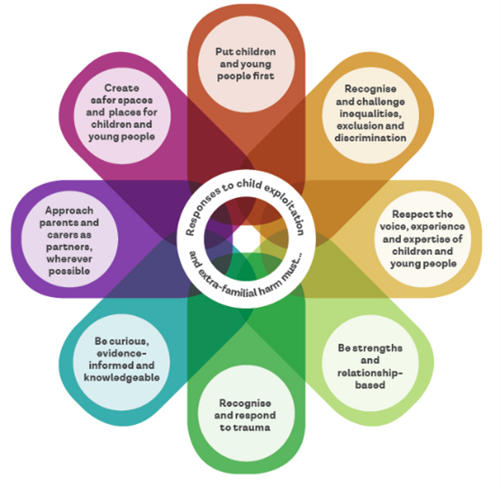
Safer Connections take a contextual safeguarding approach and is guided by both local and national frameworks, including the TCE Multi-Agency Practice Principles. These principles shape our culture, behaviours and decision-making:
These principles are not just values — they are practice commitments. They guide our work with children, our collaboration with partners and our strategic leadership across the city.
Children’s Practice Team
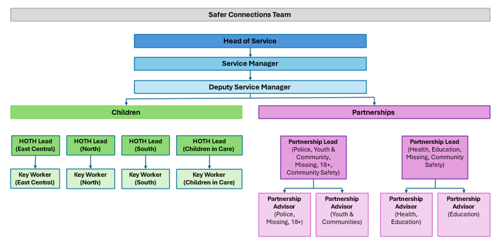
The Children’s Practice Team works directly with children and families where risks outside the home have been identified. Their aim is to disrupt harm and build safety through intensive, trauma-informed support. This includes leading strategy discussions, coordinating responses to missing episodes, facilitating family network meetings and delivering direct work with children and families.
The four Children’s Practice Leads provide consultation to lead professionals and contribute to multi-agency planning, ensuring responses are tailored and responsive to each child’s needs. They chair Daily and Weekly Incident Briefings to monitor HOtH-related police and missing reports, triage referrals alongside the First Assessment Service and lead all statutory strategy meetings where HOtH is the primary concern.
The Practice Leads also supervise HOtH Specialist Keyworkers, who support children at medium to high risk of harm outside the home. Through trusted one-to-one relationships they contribute to safety planning rooted in lived experience, deliver peer group interventions, work jointly with professionals and support statutory plans and contextual assessments.
The Partnership Team
The Partnership Team leads on inter-agency coordination and system development to address harm in the spaces children inhabit—such as schools, peer groups, public areas and online environments. Working closely with education, police, health, youth services and community organisations, the team identifies gaps in contextual safeguarding practice and develops new initiatives to strengthen local responses. Their work is rooted in the HOtH strategy and informed by learning from Child Safeguarding Practice Reviews (CSPRs).
The team supports strong information sharing and joint planning across agencies, offering consultations on individual cases, peer groups, or locations. They lead peer and location mapping, facilitate complex strategy discussions and coordinate responses to missing and pre-missing concerns. Through training, workshops, and professional guidance, they build capacity across the system to embed contextual safeguarding approaches and ensure a coherent, citywide response to harm outside the home.
With a strong community focus, the Partnership Team works to directly influence and improve the environments where children live, learn and socialise. They co-develop targeted interventions, lead community engagement and support funding bids aligned with the Violence Reduction Partnership Plan. Their work ensures that the places children spend time are made safer through collaborative, preventative action.
Bristol’s Multi-Agency Child Exploitation (MACE) Framework provides a coordinated structure for identifying, assessing and responding to child exploitation and Harm Outside the Home (HOtH). It enables multi-agency planning and disruption activity through layered oversight, from daily incident monitoring to strategic review, ensuring that intelligence is shared, concerns are tracked and responses are aligned across the system.
The framework supports escalation of persistent risks, emerging hotspots, addressing factors which may be preventing children’s plans from progressing and ensuring that strategic leaders are sighted on key issues and can make informed decisions. By connecting operational practice with strategic governance, MACE promotes inter-agency collaboration, shared accountability, and strengthens the city’s collective ability to safeguard children in the contexts they inhabit.
The Daily Incident Briefing (DIB) is a multi-agency meeting held each morning by Safer Connections and core partners. It reviews all Harm Outside the Home (HOtH) incidents reported by police and missing episodes from the previous 24 hours. The purpose is to ensure immediate, coordinated safeguarding action—enabling timely information sharing, rapid risk assessment and joint planning across statutory and non-statutory services. This daily rhythm supports a proactive, preventative approach to contextual safeguarding, ensuring that emerging concerns are identified and addressed before they escalate.
The Weekly Incident Briefing (WIB) provides a reflective space for internal partners to review the week’s key incidents and the actions taken in response. It ensures continuity, accountability and shared oversight of HOtH concerns, helping to track patterns, escalate persistent risks and maintain a joined-up understanding of the citywide safeguarding landscape. WIB also supports system learning by identifying gaps, highlighting good practice and informing future planning.
Pre-MACE (Neighbourhood-focussed) meetings take place monthly across Bristol’s localities (South, North, East Central and Through Care) and are chaired by the Deputy Service Manager (DSM) for Safer Connections. These meetings discuss and review children open to children’s social care and identified as at high risk of HOtH, providing a space for reviewing individual safety plans and coordinating multi-agency responses to contextual risk. Pre-MACE’s role is to identify persistent or increasing concerns, themes and systemic barriers and escalate these to Operational MACE where needed.
Operational MACE is a monthly citywide panel chaired by the Head of Service for the First Assessment Service & YJS and the Detective Inspector for the Police Early Intervention Team. It provides multi-agency oversight of children open to children’s social care and who are experiencing significant and often complex risks in relation to HOtH. The panel aims to ensure risk reduction plans are robust, coordinated and progressing. The panel maintains a joint action log, supports disruption activity and ensures that responses are informed by intelligence, lived experience and professional insight. It also acts as a bridge between frontline practice and strategic oversight.
Strategic MACE meets quarterly and is chaired by the Director of Children & Families services. It oversees the city’s strategic response to exploitation and HOtH, including cross-border safeguarding, complex group-based concerns and thematic trends. The panel uses system-wide data and learning from CSPRs to inform policy, commissioning and workforce development. Strategic MACE ensures that Bristol’s safeguarding system remains responsive, joined-up and focused on creating safer contexts for children and young people. Strategic MACE reports into the Preventing Serious Violence Board.
Safer Connections is committed to continuous learning, accountability and impact. Our outcomes framework is grounded in both qualitative insight and systemic analysis, helping us understand what’s working, what needs to change and where we can go further.
We measure our impact through:
Monthly Internal Audits: We conduct regular audits of Safer Connections’ work to identify both individual and systemic strengths as well as barriers to earlier, more effective intervention. These reviews inform practice development, supervision and citywide learning.
Relational Feedback Loops: We actively listen to our partners across social care, education, health, policing, and the community, to shape a service that is responsive, timely and grounded in real-world need. Our model is built on trust, flexibility and co-design.
Upskilling the System: We support the ongoing development of professionals across Bristol City Council and partner agencies, bringing the latest evidence-based learning into everyday practice. This includes training, reflective spaces and access to tools that support contextual safeguarding.
Developing a Risk Outside the Home (ROTH) Pathway: We are leading the development of a robust ROTH pathway to ensure that contextual safeguarding responses are timely, proportionate and effective. This pathway will provide clear guidance for professionals navigating complex extra-familial risk and ensure that children receive the right support at the right time.
If you are concerned a child is at immediate risk of harm, dial 999.
If you have safeguarding concerns for a child:
Call: First Response on 0117 903 6444
If there is evidence that a child is experiencing harm, this is the statutory route. Safer Connections supports First Response to review HOtH-related referrals and contributes to onward assessment and planning.
To request targeted support for children with complex HOtH needs:
Complete: a Request for Targeted Support form
This pathway enables professionals to request intensive, multi-agency support for children where contextual risks require coordinated intervention.
For further information around threshold guidelines see the Keeping Bristol Safe Partnership’s Indicators of Need document.
If you are acting in a professional capacity, you can share intelligence about vulnerable or exploited individuals, suspected exploiters, or organised crime via the Avon and Somerset Police intelligence portal.
For training, consultation or to request peer/location mapping support:
Email: saferconnections@bristol.gov.uk
We offer professional guidance, contextual safeguarding and bespoke training and mapping support to help partners respond to emerging HOtH concerns. Requesting Safer Connections support does not replace your statutory duty to report safeguarding concerns.
Bristol Harm Outside the Home Strategy 2025-2030
Avon & Somerset Serious Violence Strategic Needs Assessment 2024-2025
Avon & Somerset Violence Reduction Partnership Annual Report 2024-2025